
Antonio Stradivari's home/workshop still standing in Cremona in S.Agata parish. He lived here with his wife Francesca Ferraboschi and his children until 1680 when he moved his family in a new house in front of the S.Domenico church in Cremona.
The Sabionari guitar is one of the five surviving guitars made by Stradivari. It was built in 1679 in the house-workshop that still stands in Cremona, in the Sant’Agata district, and was the first of a series of three guitars built to the same design in subsequent years (1684 and 1688). It was an innovative and successful design: a guitar with a vibrating string length of no less than 74 cm, at least 7 cm longer than the standard, with the aim of achieving greater resonance and a richer harmonic content. Dating the wood of the soundboard has revealed that it was made by joining two pieces of highly seasoned resonance spruce. One is dated 1616 and the other 1620.
In 1679, the Baroque guitar was at the height of its popularity in Europe. Originally a popular instrument in Spain, it spread to Italy in the early seventeenth century and, by the second half of the century, had reached the most important European courts, including those of France and England. The Sun King, Louis XIV, in Paris, and King Charles II, in London, along with their respective courts, had developed a passion for these instruments, learned to play them, and invited guitarists from Italy, such as Francesco Corbetta, who spent years moving between the two courts and dedicated many of his compositions to the two kings and to several noble courtiers.
A letter dated 1854, written on the occasion of a change of ownership, made it possible to reconstruct the early history of the Sabionari guitar. This instrument was never sold by Stradivari himself. Like some of his violins, it is believed to have been among the instruments he used to showcase his finest craftsmanship to prospective clients. It was his son Paolo who, almost a century later, around 1770, sold it to Giovanni Sabionari, a wealthy merchant from Ferrara. The financial difficulties experienced by Sabionari, which affected his children after his death (around 1790), forced the family to sell the guitar to Filippo Benetti, an art dealer and bookseller from Ferrara.
In 1854, the Sabionari passed into the hands of the landowner Vincenzo Tioli. In 1888, it was exhibited in the Music Pavilion at the International Exhibition in Bologna, organised under the high patronage of the House of Savoy, the Italian royal family, with Giuseppe Verdi and Arrigo Boito serving as presidents. This veritable Wunderkammer of music brought together collections of instruments by Stradivari, Amati and Guarneri from across Europe.
The guitar was purchased in Bologna by its current owners in the 1930s from a certain Bagnoli, who shortly beforehand had offered it for sale to the Stradivarian Museum in Cremona. The museum displayed artefacts from Stradivari’s workshop but owned no instruments by Amati, Stradivari or Guarneri, as these had by then become dispersed throughout the world. Interest was focused primarily on bowed string instruments, and it would have seemed unusual for the first instrument to return to Cremona to be a guitar. The sale therefore never went through.
In 1948, the Sabionari was presented to Andrés Segovia, who was visiting Bologna to attend a guitar congress. The great maestro was delighted to examine it and wished to sign the back of the guitar, dedicating it to Stradivari with the inscription: “Two centuries later” (Due secoli più tarde), Bologna, 1948. Photographs and an account of the event have since been discovered.
Research into Stradivari’s guitars took several more decades to gain momentum, but by the late 1990s the first publications began to appear, featuring historical and organological analyses. In 2011, the current owners entrusted the Sabionari to the French expert duo Sinier de Ridder for conservation restoration. During the process, however, it became clear that the guitar could be brought back to playing condition. In 2012, it was used for the world’s first recording of a Stradivari guitar, and since 2013 it has been on display at the Violin Museum in Cremona as part of the Friends of Stradivari collection. In 2018, it was one of 21 Stradivari instruments exhibited at the Tokyo Stradivarius Festival 2018, the largest exhibition of its kind ever organised.
Thanks to the Violin Museum, four recordings, concerts, the dedicated website sabionari.com and the YouTube channel @sabionari, the guitar is now famous worldwide and has accumulated millions of listens.
Antonio Stradivari's home/workshop still standing in Cremona in S.Agata parish. He lived here with his wife Francesca Ferraboschi and his children until 1680 when he moved his family in a new house in front of the S.Domenico church in Cremona.

This letter written in 1854, accompanied the guitar.
From : Filippo Benetti
Address : Most honourable Engineer Vincenzo Tioli Bologna
Dear Friend,
Your kindest paper is written on last February 19 : but I did not have it until
the present moment and I don't know how it is.
The guitar is of Stradivari and the authentication is born by the neck doing the
legalization by his own hand.
This guitar was purchased in Cremona from the descendants of the family who sold
it to a certain Giovanni Sabionari and I purchased it from him : but maintain it as
the pure truth, that the instrument is true and real manufactured by the above
mentioned Antonio and that he made only that one.
This is what I owed you in due answer, meantime I submit to your orders, I am
already collecting other things and manuscripts that at your coming we will make
other bargains.
Meanwhile believe with distinguished esteem .
Ferrara First of May 1854
Very humble servant of you best Sir
Filippo Benetti

In 1888, the Sabionari guitar was displayed in the wonderful Music Pavilion at the International Exhibition in Bologna, The guitar was in the showcase n. 12 close to the Stradivarius harp and other instruments.


On 5 december 1948 the current owners brought the Sabionari to Andrés Segovia. He was in Bologna for the 10th Italian and International Conference about guitar. The Master wanted to write inside the guitar a dedication to Stradivari "Due secoli piu tarde" (Mixed Italian and Spanish, "Two centuries later") and his signature.
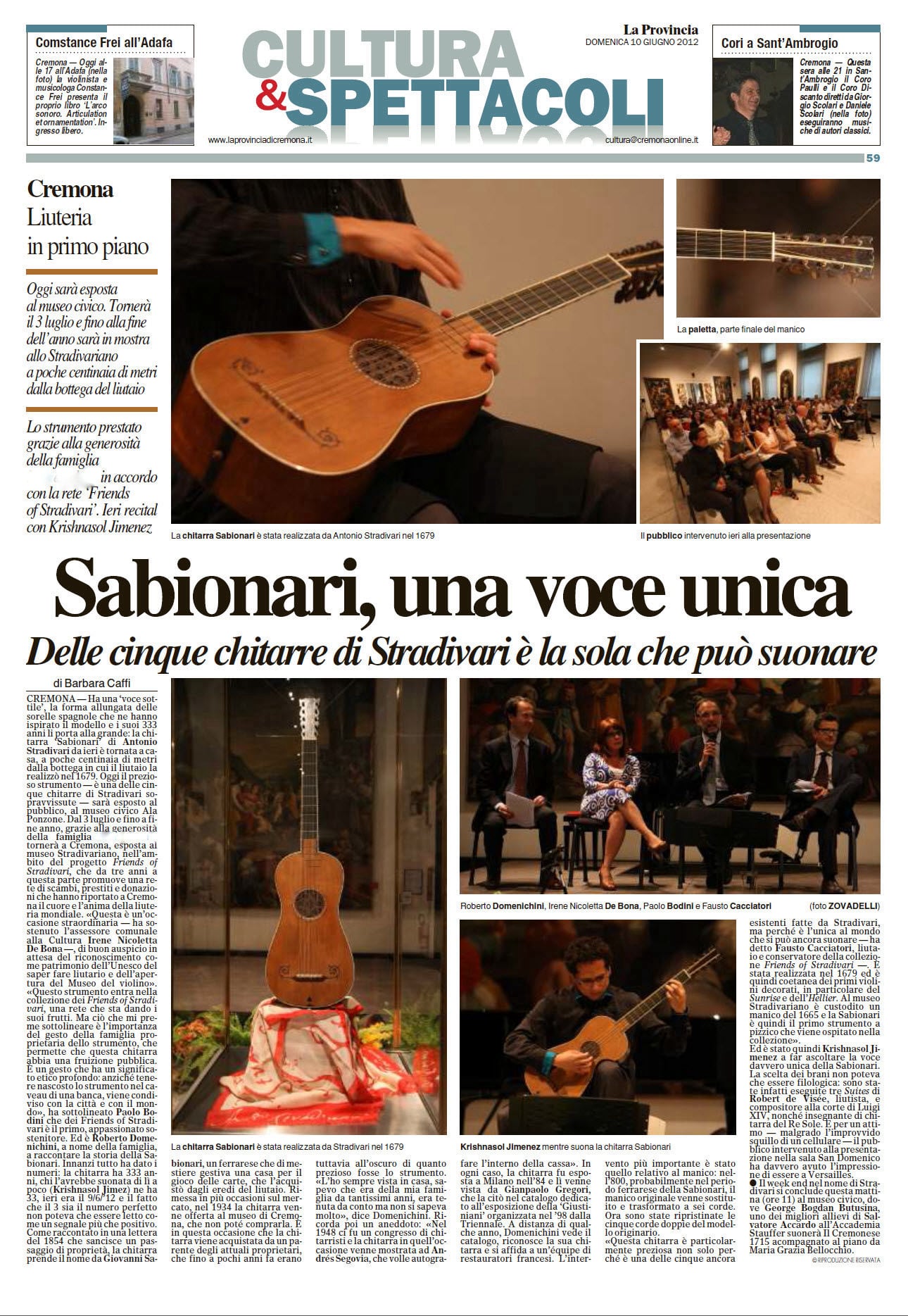
On april 2011 the owners entrusted the Sabionari guitar to the expert hands of Sinier de Ridder for a conservative restauration, that gave also back to the guitar its original baroque sound. In 2012 the guitar returned to Cremona. In the photo the article of the local newspaper about the presentation of the guitar to the city and the first concert.
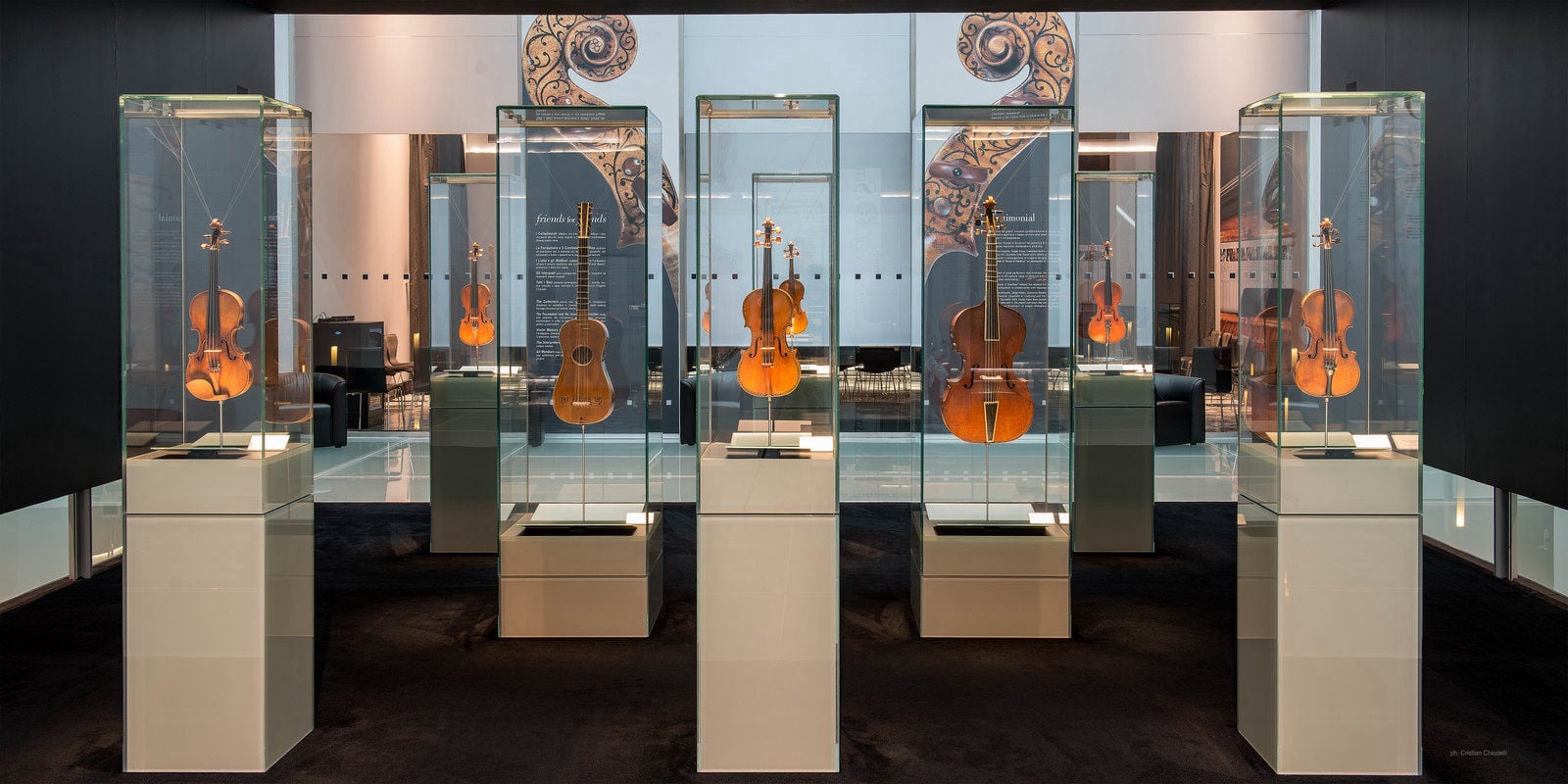
Starting from 2013 the Sabionari has been on show in the Museo del Violino in Cremona. Here, it was able to be reunited with other instruments alongside which it had remained on display in Antonio Stradivari’s workshop for many years—such as the inlaid *Hellier* violin of 1679 (pictured in the center) or the *Messiah* violin of 1716.
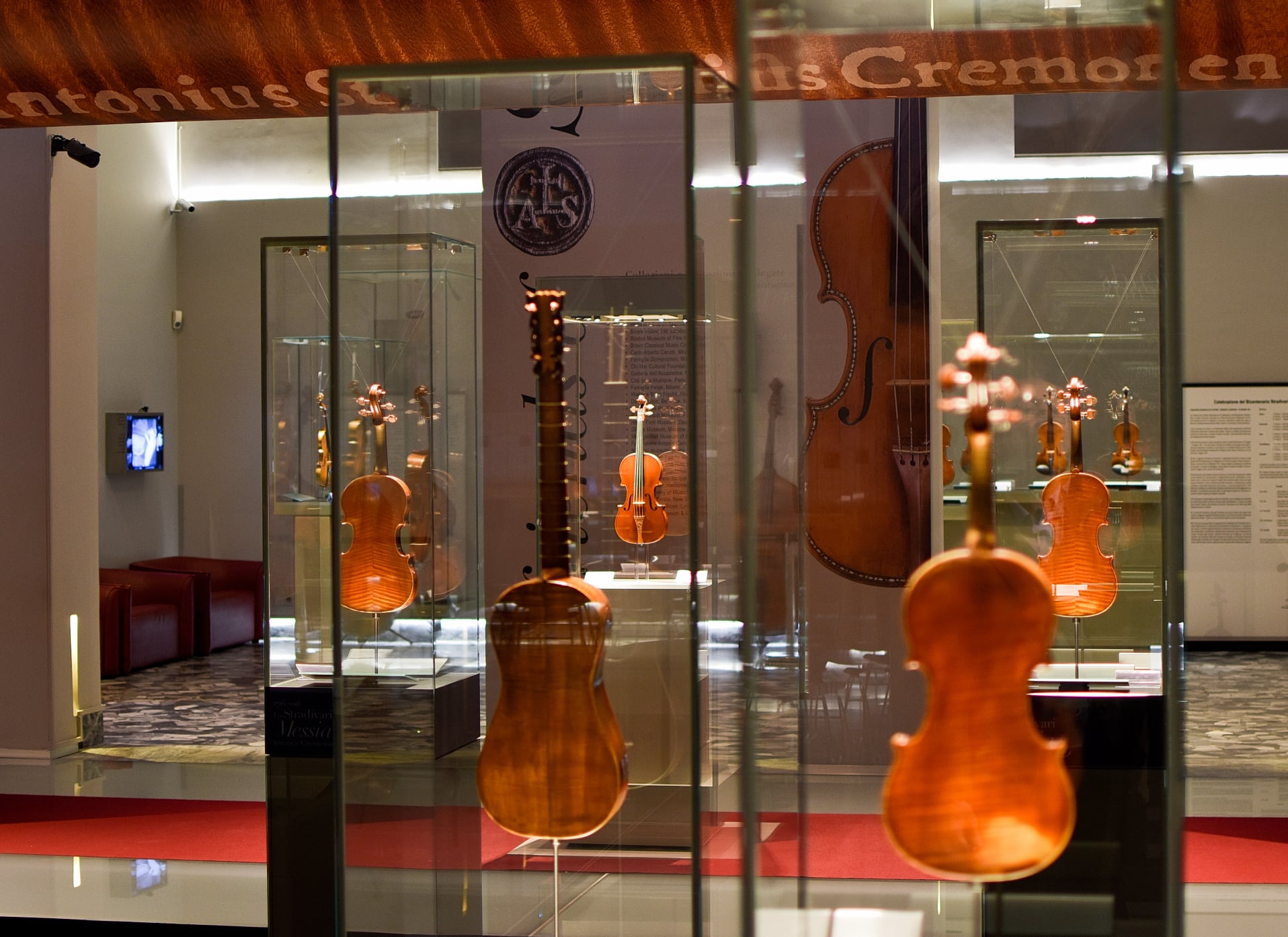
The Sabionari in Museo del Violino in 2016, on show at Museo del Violino in front of with the Stradivarius 1716 violin *Messiah*
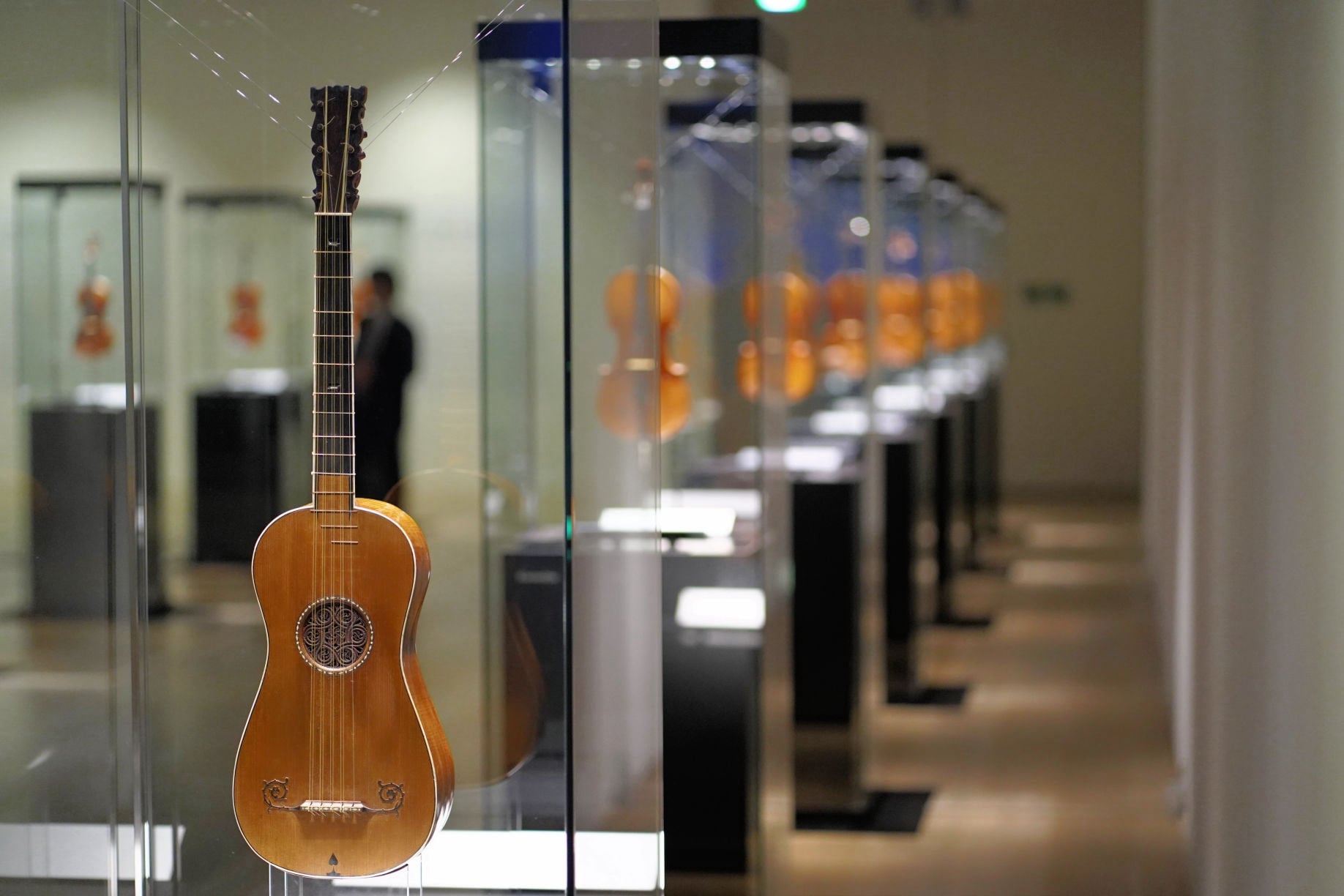
In 2018, the guitar travelled to Tokyo for the Tokyo Stradivarius Festival, where it was displayed as part of the largest exhibition of Stradivarius instruments ever organized: 21 Stradivarius
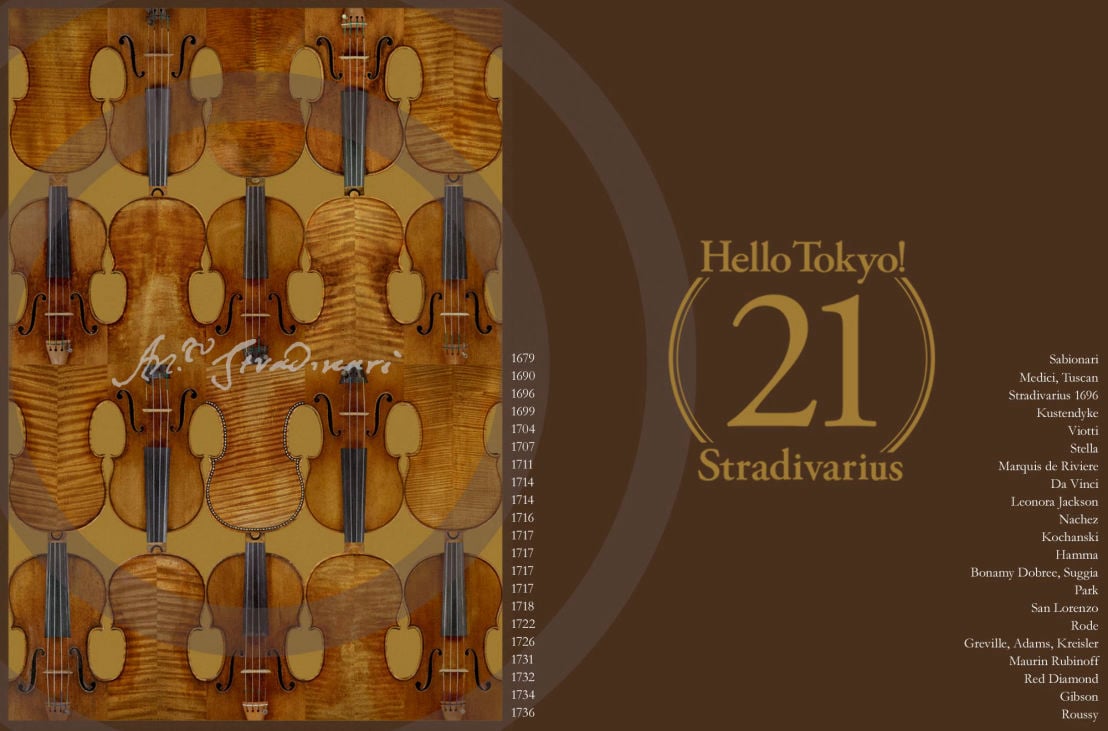
Here is the list of the instruments on show.

Website Software